




“L’ AMOUR TOUJOURS: How long is your summer love destined to last? – Chapter 3
26 July 2016
L’Efficacia del Metodo ETaC di Paul Ekman nel proteggere gli “obiettivi sensibili”
3 November 2016

A snapshot of the present, to outline the future of companies.
A study conducted by Josh Bersin of Deloitte – a leading HR consulting firm – highlighted that in 2014, overall US spending on corporate training increased by 10% over the previous year, to a figure of around $75 billion (it is believed that more than $140 billion was spent worldwide in 2014: the US, in essence, is the country that has invested the most in training applicable to the business world). According to the authors, this positive trend has been going on for a good five years, with constant average increases of 10% year on year.
Josh Bersin explains how the amount of investment made in corporate training is a good thermometer of economic activity: when companies slow down, training expenditure is often cut, and as soon as business picks up again, resources are reinvested in training, both in sales and in the development of top and middle management.
Investing in training is therefore a reflection of a company’s well-being: it shows its proactive attitude and desire to innovate, its ability to stand out firmly in the global market.
This would seem to be comforting news. But there is an ‘Achilles heel’, a weak point, that needs to be taken into serious consideration.
Research conducted by Eduardo Salas, professor of psychology and programme director of the Institute for Simulation & Training at the University of Central Florida, found that roughly 90 per cent of the new skills acquired during training can be almost completely forgotten by participants within a year of training, unless specific follow-up training is carried out to recapitulate the topics covered and accompanied by evaluation tests that measure what has been learned and remembered.
According to Prof. Sales, apparently, what happens before and after a training course is therefore just as crucial as the actual learning.
Most companies wrongly assume that if an unskilled worker undergoes training, he or she can immediately be ‘transformed’ into a skilled, diligent and experienced worker right from the start. But it is often the training methodology that makes the difference, coupled, of course, with the participant’s motivation to learn and get involved.
Checking the learning after the training phase is an indispensable advantage: to safeguard the results, checking whether the content learnt by the employees is transformed into real competences – maintained or developed over time – is crucial.
.
What are the most effective training methodologies, and how much are the investments made by Italian companies to develop their resources?
A research conducted by ASFOR in 2015 (XI ASFOR research on the Demand for Managerial Training) highlights how companies present in Italy follow two-speed paths with regard to investment in training, depending on the market in which they operate: “…companies focused on the domestic market struggle to keep the resources allocated to training unchanged…there is instead a type of company that has increased investment. These companies have two characteristics in common: they are engaged in the process of competitive repositioning in global markets and are implementing a rapid growth path in which change, internationalisation and innovation are integrated.“
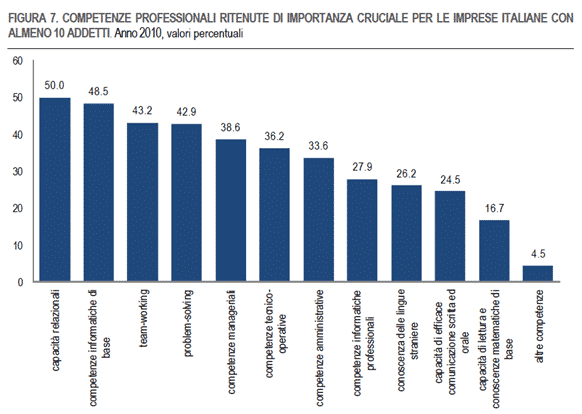
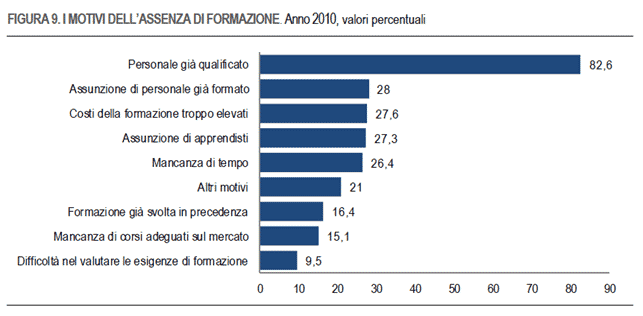
A longitudinal study conducted by ISTAT (period taken into consideration: 2005 to 2010) and published on 1 August 2013 highlights a paradox between the opinions of Italian top managers regarding the recognised usefulness of training and the real investment made in corporate training itself: companies seek out quality training, especially in emotional and relational skills, and recognise its benefits in terms of concrete results; but conversely, a good 44.1% of the same companies avoid training their employees, as they consider them to be already sufficiently qualified (at least 82.6% of these companies), or look for employees who have already been trained previously and elsewhere to be hired (28% of the sample declare this). Here are the data that emerged from the study:
Complicating matters, a report by the World Economic Forum 2016 – which examines the employment, skills and workforce strategy for the future – shows that five years from now, more than a third of the skills (as many as 35%) that are considered important in today’s workforce will be subject to change, i.e. considered secondary:
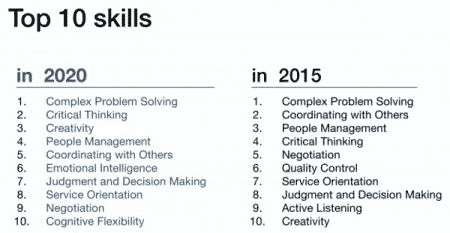
Source: ExpoTraining Observatory
How, then, can one respond to the new demands that may emerge from the global market if one decides to disinvest in the training and continuing education of workers?
If we add the data concerning the physiological mnemonic forgetting that occurs as a result of learning (highlighted by Prof. Eduardo Salas’ research described above), how can we finally ensure that what was previously learned is not forgotten by employees, and how can they themselves cope with the new demands that will be indispensable in the business of the future, if they do not receive support and backing from companies?
There is therefore a need to change the Culture of Training, drawing on methodologies that draw on studies and research in the field of learning and development psychology, in order to maximise results and contain collateral costs for companies.
Maximising is important, but only if it is accompanied by focusing on quality: the results of good training have a marked impact on a company’s results.
Therefore, choosing which skills to develop and the most effective training methodology is an investment that always pays off.
What do the largest multinational companies look for when they choose to invest in training?
- RESPECT FOR HISTORY, TO DEVELOP THE FUTURE TOGETHER:requiring a meeting with the Management to define together the training macro-objectives is crucial, as well as a duty to know the history and values that a company proudly carries on in the world: a brand is much more than its products.
Each training proposal should be designed according to the specific needs of the company, so as to enhance its tradition and brand, but innovating and developing the skills of the people working in it.
Respect for the Past, adapting to the needs of the Future, in a new and distinctive way. - CLEARING EXPERIENCE TO MEET REAL NEEDS: every large company is characterised by the professional multidisciplinarity of its employees, who are also characterised by different academic backgrounds. Good training should respond in an optimal and specialised manner, providing targeted support according to the context or the specific needs of individual professionals. Calling for a preliminary meeting with a representative selection of participants aimed at deepening expectations and needs, collecting useful concrete cases, and customising the intervention programme for them, always makes a difference: it stimulates participants, actively involves them in the co-construction of the training and, above all, provides them with what they really need, without superfluous additions.
- OUT OF THE LESSONS – THE ADVANTAGES OF “LEARNING BY DOING”: leading companies wish to obtain training proposals that allow participants to acquire through practical experience the skills they need: this choice allows for greater involvement and facilitates the recall of content. Each theoretical content becomes an observable and replicable behaviour, it is learnt in a simpler, more spontaneous and immediate way. A training style that focuses on ‘how to do’ rather than ‘what to do’ – through role playing, examples and targeted live exercises – can make participants fully operational already at the end of a workshop.
- PRODUCTING POST-TRAINING: in the transition moment between the end of a course and the consolidation of skills, being able to receive available assistance, tutoring or methodological supervision with respect to the content learnt in the classroom by one’s trainer is reassuring.
This service is a truly appreciated added value for companies and individuals, and saves time on the learning process. Being able to count on support in real time (or via e-mail, telephone, Skype, etc.) makes it possible to discuss any areas of interest and/or the analysis of situations to be handled, share the successes resulting from the application of classroom methodologies and provide any support in the application of newly acquired skills.
.
The training should be tailored to the specific context or needs of the individual professional.
The training style is based on the ‘how to do’ rather than the ‘what to do’.
The trainer’s ability to share his or her knowledge and experience with the company’s employees is also a valuable asset.